

Keywords: agri value chain, agricultural value chain India, farm to fork value addition
What is a Value Chain?
A value chain in agribusiness describes the sequence of activities and actors involved to bring a product from farm level to the final consumer — while adding “value” at each stage.
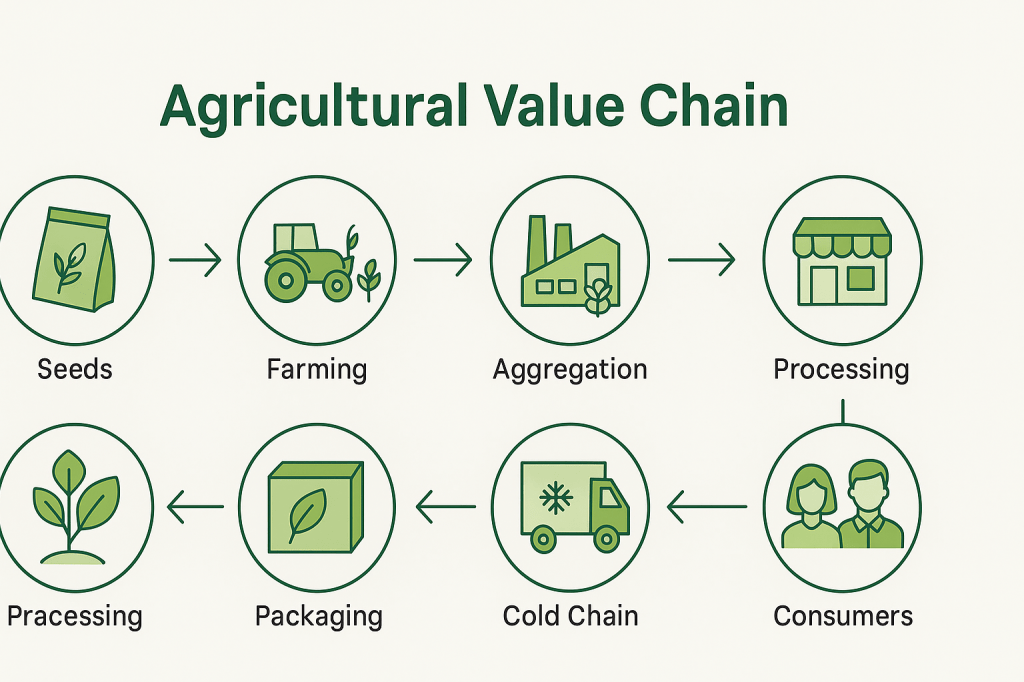
Stages in an Agribusiness Value Chain
| Stage | Activities / Actors |
|---|---|
| Input Supply | Seeds, fertilisers, machinery suppliers, agro-input dealers |
| Production | Farmers (crops, horticulture, dairy, livestock, fisheries) |
| Aggregation & Collection | Mandis, farmer-producer organisations (FPO), collection centres |
| Processing & Value Addition | Food processing units, cold-storage, grading, packaging |
| Logistics & Distribution | Transporters, cold-chains, warehousing, supply chain firms |
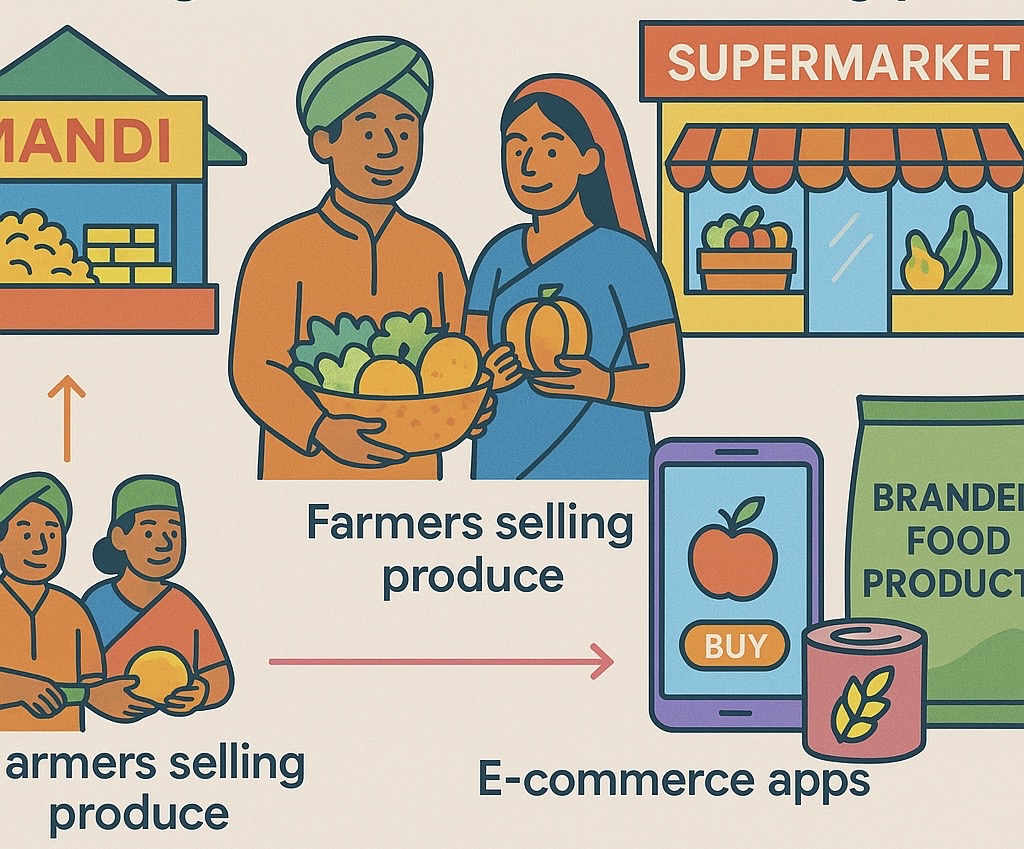
| Marketing & Retail | Mandis, wholesalers, retailers, organised retail, exports, e-commerce |
| Support & Services | Finance, insurance, quality control labs, extension services |
Why Value Chains Matter in Agribusiness
- Value addition & better incomes: Instead of selling raw produce (often at low prices), farmers and stakeholders can gain more if produce is processed, packaged, branded, and sold as value-added products.
- Reduced wastage & improved quality: Efficient chains — with processing, cold-storage and better logistics — prevent post-harvest losses. This helps especially perishable produce like fruits, vegetables, dairy.
- Market linkages & stability: Along a good value chain, small farmers get better access to markets, quality inputs, timely payments — reducing dependence on multiple middlemen and volatile mandi prices.
- Employment & entrepreneurship: Value-added processing units, cold-storage, packaging, retail, logistics — all create non-farm employment opportunities.
Status & Potential in India
- A recent study reports that across India’s agricultural value chain, there are about 40 business-worth segments with growth potential; these include inputs, food processing, agritech, supply-chain logistics, etc.
- Value-addition, especially in dairy, horticulture, fruits/vegetables, and processed foods, offers high potential.
Real-World Example 2025: Agri-Processing & Export Surge
In 2025, India’s agricultural exports surged amid strong global demand. The growth was driven by processed foods, fruits/vegetables, and improved supply-chain capability — reflecting the growing strength of agribusiness value chains.
Many states and private players are investing in cold-storage, processing units, and food-parks — showing that value-chains are being institutionalised, not just left informal.
Challenges in Indian Agribusiness Value Chains
- Fragmentation and small landholdings — making aggregation difficult.
- Lack of proper infrastructure — cold storage, warehouses, transport, processing units.
- Market inefficiencies — poor linkages between farmers and final markets; many middlemen; price volatility.
- High wastage — especially for perishables, due to delays, improper storage, lack of cold-chain.
What Needs to be Done / What Students Should Know
- Strategies for value chain integration — linking input supply, farmer groups, processing, logistics, marketing.
- Role of FPOs / cooperatives / companies — to aggregate produce, negotiate better prices, manage processing & marketing.
- Importance of infrastructure & investment — cold-storage, processing units, packaging, transport to minimise losses and add value.
- Understanding markets & demand — domestic retail, exports, changing consumer preferences (processed foods, ready-to-eat, convenience, quality).
Conclusion
Value-chain thinking is central to modern agribusiness. For an agribusiness manager (or student), understanding how value is added — and where value can be created — is vital. India’s evolving policies, rising demand for processed foods, export potential, and infrastructural investments make value-chains the core of future agribusiness growth
m
 AgriBiz Academia
Leave a comment