

Keywords: agri marketing India, agricultural marketing trends India 2025, agrimarketing concepts
What is Agricultural Marketing?
Agricultural marketing refers to the processes and activities involved in moving farm produce from producers to consumers — including harvesting, collection, grading, packaging, storage, transport, processing, distribution, wholesale/retail, and export.
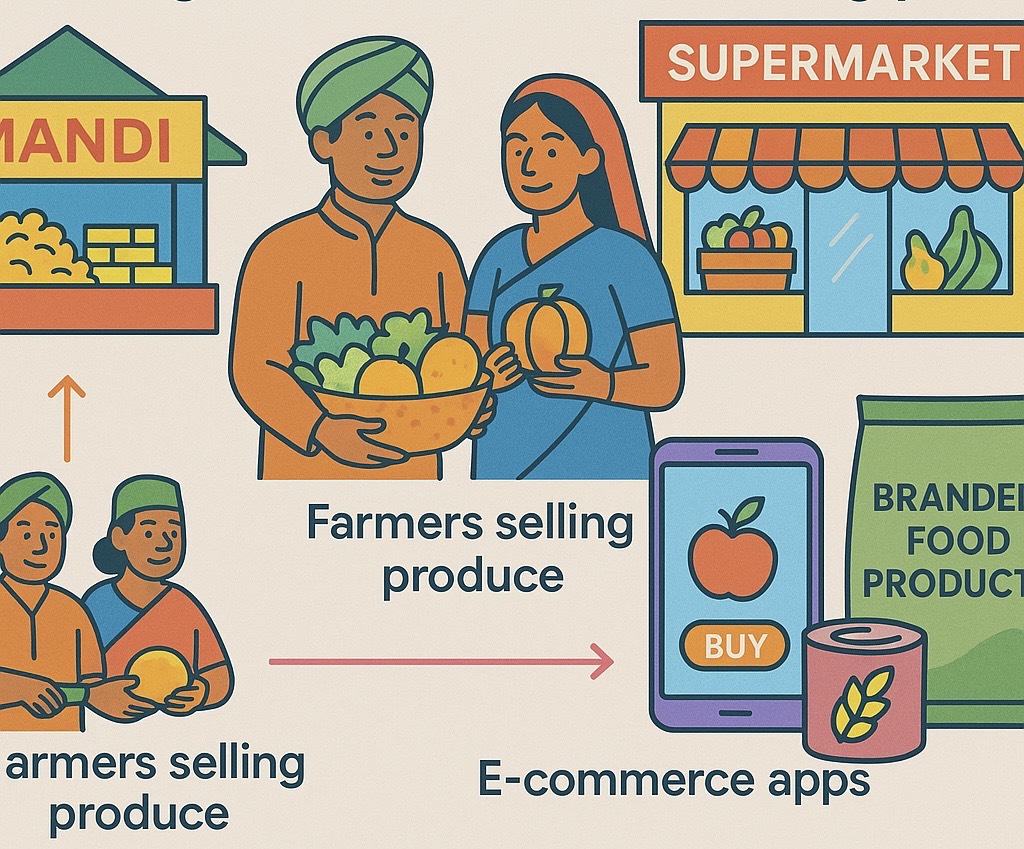
Traditional vs Modern Agri-Marketing
| Approach | Characteristics |
|---|---|
| Traditional | Mandis (APMCs), brokers/middlemen, open-auction markets, little value-addition, limited grading/processing, price volatility |
| Modern / Evolved | Direct marketing, contract farming, FPOs/cooperatives, processing & packaging, e-markets, organised retail, exports, agritech platforms |
4 Ps of Agri Marketing (applied to Indian context)
- Product: Quality, grading, standardisation, packaging, processing, branding — e.g. packaged rice, branded pulses, ready-to-eat snacks, dairy products.
- Price: Minimum Support Price (MSP), mandi prices, demand–supply dynamics, processing costs, grading premiums — affects what farmers / processors earn.
- Place (Distribution): Mandis, wholesale markets, retail stores, e-commerce platforms, direct procurement — reach from farm-gate to consumer.
- Promotion: Branding, packaging, quality labels (organic, A2 milk, GI tags), digital marketing, export promotion, consumer awareness campaigns.
Key Trends & Developments (2024–25) in Indian Agri-Marketing
- Growing interest in value-added foods, processed foods, dairy and packaged products: As consumer preferences shift, demand for processed, packaged and branded agri-products (milk, pulses, snacks, ready-to-eat) is rising. India’s food-processing and export potential is expanding.
- Expansion of agribusiness infrastructure and modern supply-chains: To support value-addition and marketing, better warehousing, cold-storage, logistics and export facilities are being built.
- Rise of agribusiness entrepreneurship & agritech start-ups: Input supply, processing, e-markets, farm-services, supply-chain management, and start-ups are increasingly engaging in agri-marketing roles — opening career and business opportunities.
Example: Dairy & Processed Food Marketing in 2025
The dairy sector in India is undergoing transformation: companies are launching protein-based dairy products and expanding retail network, responding to rising health consciousness and demand for value-added dairy items.
Similarly, export demand for processed agricultural products has surged, making marketing, packaging, quality control and supply-chain management more important than ever.
What Students Should Learn / Focus On
- How to design marketing strategies for agricultural products (product, price, place, promotion)
- Understanding of supply-chain problems and how marketing + logistics + processing can solve them
- The potential of value-added products and processed foods
- Role of FPOs, cooperatives, agritech platforms in modern agri-marketing
- Insights on current consumer demand (packaged food, health/organic products, convenience) and export opportunities
Conclusion
Agricultural marketing in India is evolving rapidly — from traditional mandis and brokers to integrated agribusiness marketing systems involving value-addition, processing, packaging, brand building, and exports. As agribusiness professionals or students, understanding marketing dynamics is essential to create value, improve farmer incomes, and meet changing consumer and market demands.
 AgriBiz Academia
Leave a comment